
Johnson County Court Records After Arrest
After a Johnson County jail arrest, two record tracks exist at the same time. The custody track starts at booking and is searched through the Johnson County jail inmate records path. The court track starts when a complaint, information, indictment, citation, or related filing reaches the court. The court record is where filed charges, court dates, bond conditions, motions, pleas, dismissals, deferred adjudication, convictions, and other case events appear.
Johnson County's official District Attorney page explains the prosecution split. Both the county attorney and district attorney represent the State of Texas in criminal cases and work with law-enforcement officers during investigation and preparation. The county attorney typically handles misdemeanor criminal cases. The district attorney typically handles felony cases. That local split matters when a jail arrest becomes a court record because the filing office, court, and clerk route can differ by charge level.
Find Johnson County Court Records After Arrest
Johnson County's online-records page links the County & District Court Records portal. The research file identified the Tyler Odyssey Public Access portal as the public case-search channel for Johnson County court records. The portal presents choices such as All Courts, All County Courts, and All District Courts, with criminal records or citation payment paths. A case may not appear at once after booking if the prosecutor has not filed yet or if the case belongs in a municipal or justice court.
- Confirm the spelling used by the jail roster, including middle name or suffix if shown.
- Open the Johnson County court-records portal from the county online-records path.
- Select the court group that fits the case, such as All Courts, County Courts, or District Courts.
- Search by defendant name when the case number is unknown.
- Open the case and compare filed charges with the jail booking entry.
- Use the District Clerk for felony district-court records and the county-court path for many misdemeanors.
The Johnson County Tyler Odyssey Public Access portal is the case-search screen captured in the project manifest.
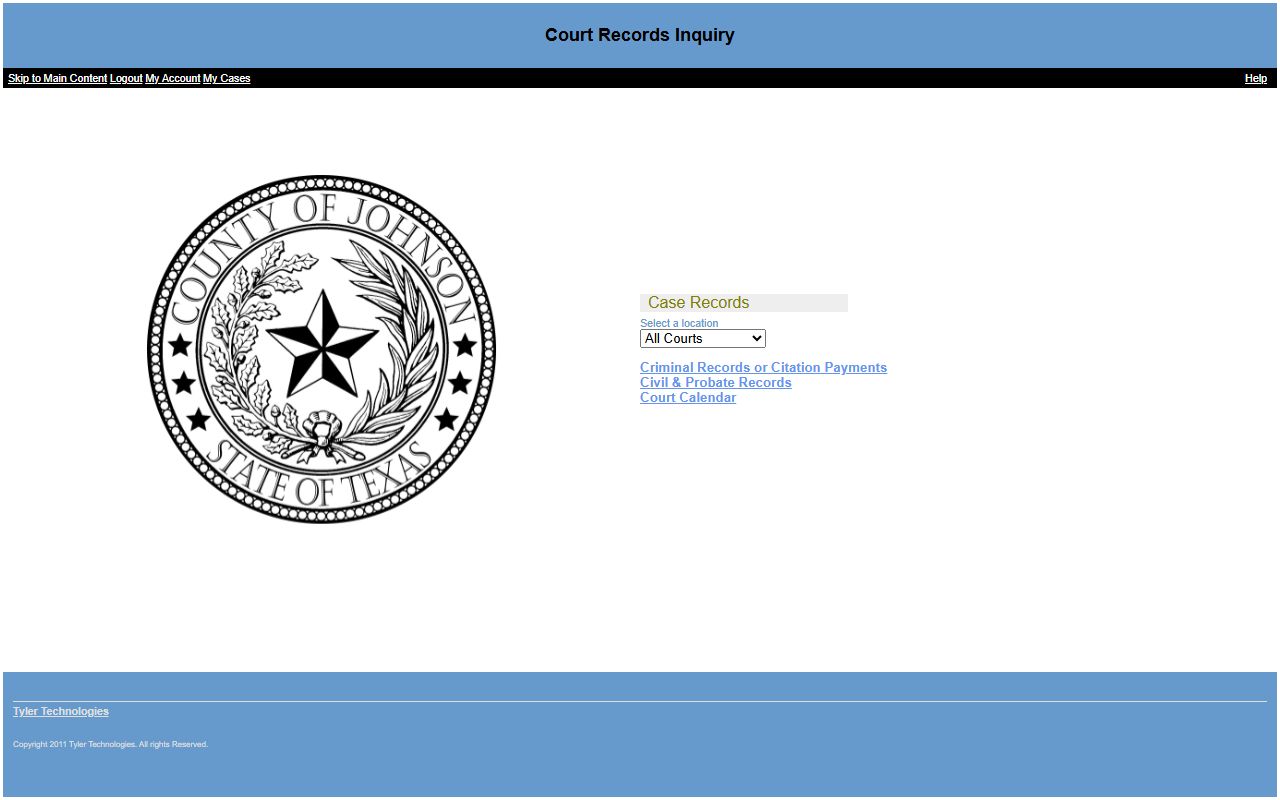
The portal is for court cases. It does not replace the jail roster for current custody or booking-photo questions.
Johnson County Court Search Fields
The research did not capture every subform inside Odyssey, so the field table stays at the entry level. That is still useful because the first choice often determines whether the user searches district, county, criminal, citation, civil, or probate material. For criminal court records after an arrest, choose the criminal or citation route, then search by name or case number as the portal allows.
| Field / Control | Type | Required | Notes |
|---|---|---|---|
| Select a location | Dropdown | Entry control | Research exposed All Courts, All County Courts, and All District Courts. |
| Criminal Records or Citation Payments | Portal category | Depends on search | Used for criminal and citation case access. |
| Civil & Probate Records | Portal category | No for jail-arrest searches | Separate from criminal arrest cases. |
| Name / Case Number | Search controls | Varies | Use defendant name if the case number is not known. |
Charging Records After Jail Arrest
A booking charge is not always the formal prosecution charge. The county attorney's crime-charges process says the first step is reporting the crime to the agency with jurisdiction, then the prosecuting attorney reviews reports, records, victim and witness statements, and prior criminal or traffic history. That review can lead to no filing, a different charge, a reduced charge, an enhanced charge, or a later indictment.
| Document | Common role | What it means for the court record |
|---|---|---|
| Complaint | Sworn allegation or early charging paper | May support a warrant, magistration, or misdemeanor prosecution. |
| Information | Prosecutor-filed charging instrument | Often used in misdemeanors and some waived-indictment cases. |
| Indictment | Grand-jury charging instrument | Common felony charging document after grand-jury action. |
Johnson County Charge Status
Charge status can change as the court case moves. A charge can be pending, amended, reduced, dismissed, transferred, deferred, pleaded, tried, or convicted. The jail roster may show the arrest or intake label, while the court file shows the charge that the prosecutor filed and the status assigned by the court. For record reading, treat the court docket and clerk record as the formal prosecution record.
| Status | Plain meaning |
|---|---|
| Pending | The case or charge is active and no final outcome is shown. |
| Amended or reduced | The filed charge changed from an earlier label or level. |
| Dismissed | The court record shows the charge ended without conviction on that count. |
| Deferred | A plea or court order may delay final adjudication while conditions are completed. |
| Convicted | A plea or verdict resulted in a conviction on that charge. |
Bond Records After Johnson County Arrest
Bond information may appear in the jail booking detail, the court record, or both. The confirmed Johnson County roster result table did not show bond at the first-stage result level. Texas release paths can include cash bond, surety bond, personal or PR bond, and no-bond holds. Holds matter because paying one bond may not release the person if a parole warrant, another-county warrant, federal hold, ICE detainer, or court commitment remains active.
| Bond or hold type | How it affects release |
|---|---|
| Cash bond | The full amount is paid as allowed by the court or jail process. |
| Surety bond | A licensed bail bond company posts the bond for the defendant. |
| Personal / PR bond | Release is based on a promise to appear, sometimes with conditions. |
| No-bond hold | Release is blocked until the judge, agency, or issuing court acts. |
Warrants Before Jail Arrest
A warrant can be the reason for the jail arrest or a hold that appears after booking. The research file points to Cleburne Municipal Court's warrant and bond page as a local example. That page says people with outstanding Cleburne municipal warrants or delinquent citations should contact the municipal court immediately, and it offers safe-harbor language for people appearing in good faith at that municipal court. That safe harbor is specific to Cleburne municipal matters. It should not be applied to felony, county, district, parole, federal, or other agencies' warrants.
For Johnson County court records after an arrest, warrant terms to watch include bench warrant, capias, bond forfeiture, failure to appear, and detainer. A detainer is another agency's request to hold or notify before release. A capias is a court order or writ used to arrest a person, often after indictment, judgment, or failure to appear.
Charges vs Convictions
An arrest and a charge are accusations. A conviction is a court outcome. This distinction is critical when reading Johnson County court records after a jail arrest because a person can be booked, charged, released, dismissed, deferred, acquitted, or convicted through different steps. Public records may show several stages, and each stage has a different meaning.
| Charge | Conviction | |
|---|---|---|
| Stage | Accusation or filed count | Final plea, verdict, or judgment outcome |
| Proof level | Based on probable cause or prosecution filing | Based on plea or proof beyond a reasonable doubt |
| Can change? | Yes, it can be amended, reduced, or dismissed | Changes usually require appeal, post-judgment action, or record-clearing process |
Sealed and Expunged Arrest Records
Texas public access is broad, but not all arrest and court records stay public forever. Texas Code of Criminal Procedure Chapter 55A covers expunction, the strongest record-clearing path for eligible arrests. Sealing or nondisclosure is different. It can limit public access while allowing some government or justice-system access. Juvenile records, medical information, security details, active investigation material, and confidential identifiers can also be restricted or redacted.
| Sealed / nondisclosed | Expunged | |
|---|---|---|
| Public visibility | Hidden from many public searches | Treated as cleared under the expunction order |
| Government access | Some agencies may retain limited access | Access is much more restricted by the order |
| Typical basis | Depends on Texas nondisclosure rules and outcome | Depends on eligibility under Chapter 55A |
DPS Records vs Local Court Records
The Texas DPS Criminal History Conviction Search is a statewide conviction-history service. It is not the Johnson County jail roster and not the Tyler Odyssey court case file. A local Johnson County court record can show pending charges, dismissals, settings, and filings that a conviction-only search may not show. A DPS search may also require payment and should be treated as a different record product.
Important: Do not use casual public-record lookups for employment, credit, housing, insurance, or other FCRA-covered screening.
Johnson County Court Record Offices
The District Clerk page identifies Dean Sullivan and lists the Guinn Justice Center, 204 South Buffalo Avenue, Cleburne, Texas 76033, phone (817) 556-6839, fax (817) 556-6120, email JCDC@johnsoncountytx.org, and Monday-Friday 8:00 a.m.-4:30 p.m. office hours. The District Attorney page identifies Hon. Timothy M. Good at the Guinn Justice Center with phone (817) 556-6802. Victim Assistance is also at the Guinn Justice Center and lists phone (817) 556-6815.
Use the jail for current custody and the clerk or court portal for filed court records. The Guinn Justice Center is not the county jail. The jail is on Ridgemar Drive, while the court and prosecutor offices are at the courthouse or justice-center location in Cleburne.